Monday, September 2, 2013

2014 Perfect Window Treatments Styles Ideas

Pick the right treatments for your windows. Get to know the available options  valances, shades, panels and more  and how to best use each treatment with these easy tips

Valances 


 A valance is a little bit of fabric that does a big job. It hangs across the top of a window, adding softness, color, and pattern to a hard architectural element. Purely decorative, a valance helps establish a room's style. At its most basic, a slip of fabric can be attached to a rod with clip rings. For more detail, add pinch pleats.

Simple Valances 


The simple valance is a casual treatment that works well for family areas such as the kitchen, breakfast room, and bathroom. In rooms where privacy isn't an issue, the valance can hang alone. When privacy is a concern, the valance easily pairs with a hard treatment, such as a blind, shade, or shutters.

Box-Pleated Valances 


Those who appreciate a classic decorating style will fall in love with the box-pleated valance. This tailored treatment is a natural in rooms where you want a formal air, such as a living room, dining room, or master bedroom. The stationary treatment's crisp stitched pleats lie flat against a mounting board, which is typically attached to the wall with simple L-shape brackets.

The box-pleated design is easily duplicated on furnishings such as table coverings, slipcovers, or bed skirts to unify a room. Here, fabric-covered buttons accent the corner pleats on the table topper to mimic the valance.

Simple Swags 


Sometimes a simply knotted scarf worn around the neck is the perfect accent for an outfit. A simple swag on a window dresses up a room the same way. A loosely slung fabric strip, unlined or lined, draped over a decorative rod or wound over a tieback at each top corner of a window frame can add an abundance of style. The middle of the fabric strip acts as a valance; the ends, whether cut into opposing diagonals or simply hemmed, softly hang down the sides of the window.

Swags can be made of luxurious fabrics to fit formal decor or dressed down in cottons befitting a cottage or country home. The beauty of this style is its simplicity, so it's most appropriate used alone on windows where privacy is not an issue.

Balloon Shades 


For the ultimate romantic gesture, nothing beats a billowy balloon shade. This sumptuous fabric shade features cascading scallops that culminate in graceful, blousy folds along the bottom. Cords strung though rings on the back make the shade movable, and as the treatment is raised, the vertical gathers create dramatic poufs. Because this treatment usually remains raised, it acts as a valance more often than a shade. The amount of fabric used--at least twice the width of the window--creates the opulent look. Large designs can get lost in the multiple gathers, so opt for solid-color or small-pattern fabrics. Be aware, too, that the number of gathers, pleats, or scallops creates different looks within the balloon-shade and valance family. An Austrian shade, for example, has less shirring and is therefore more tailored than its cousin, the balloon shade. Because this window treatment is so showy, use it in small doses.

Tie-Up Shade 


Simplicity is the name of the game with tie-up shades. Sometimes called a stagecoach-style shade, this economical treatment uses fabric in its most unconstructured form: It hangs flat from a rod or mounting board, then the bottom edge is hand-rolled or folded to the desired position. Fabric ties, ribbons, or cords hold the rolls or folds in place. Adjusting the shade requires untying and rerolling it by hand, making this treatment more decorative than functional. Consider using it where you're likely to leave the shade down to hide an unsightly view or open in a room where privacy or sunlight aren't issues.

Roman Shades 
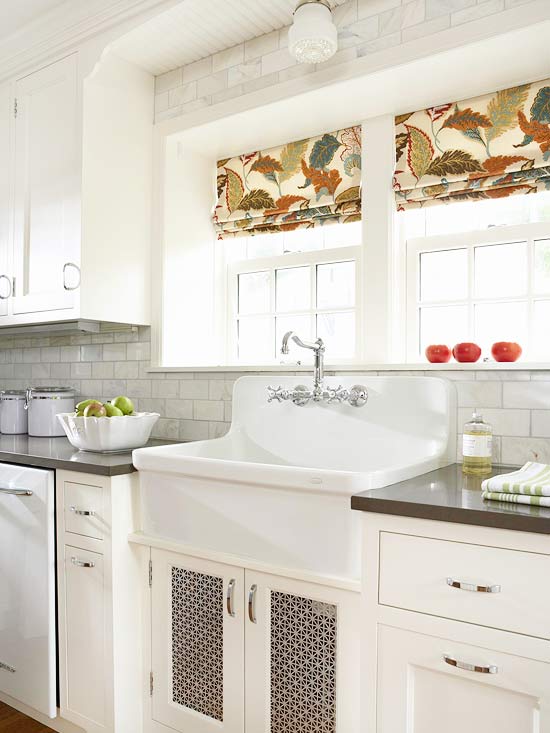

For the look of luxury without yards of flowing fabric, a Roman shade is a wise choice. When closed, the shade is a flat fabric panel. When raised, cascades of deep, horizontal folds are responsible for the tidy look. Cords strung through rings on the back of the fabric give the shade its mobility. Some Roman shades are made without dowels or lining, resulting in looser, puffier folds.

Roman Shade Tips 


A Roman shade can be mounted inside or outside a window frame. Though the shade is often used alone, it can be the practical layer combined with side panels or a valance. Appropriate almost anywhere, a Roman shade's level of formality is defined by fabric and trim choices. You could use plain muslin in a sunroom or toile in a master bedroom. Just be sure to choose fabric that can form handsome folds.

Cornices 


Think of a cornice as a wood valance, it is typically made from plywood, assembled with wood screws and corner brackets, then painted or covered with wallpaper or fabric and mounted to the wall above a window. Like a valance, a cornice can appear alone or team with another treatment. Because it is usually made of wood, a cornice benefits from being paired with a soft treatment, such as a curtain or fabric shade, to temper its hard lines. These structural lines are especially effective in rooms that lack interesting architecture. They can camouflage a window's wimpy trim or bring interest to a room that doesn't have crown moldings.

Rod-Pocket Panels 


Of the many ways to attach a drapery panel to a rod, few match the ease of the rod pocket. In this treatment, the curtain rod simply slips through a channel sewn into the panel's top edge. The tighter the fit, the more dramatic the shirring. For a ruffled header, sew a pocket a few inches down from the top edge; when the rod is pushed through, the fabric above it fans out to form a ruffle.

Rod Pocket Panels 


Rod-pocket panels are commonly made of lightweight fabrics and left unlined for a casual look. But don't overlook this style for more formal decor. For a sumptuous style statement, consider plush velvet panels shirred tightly on a substantial rod. Because panels don't slide easily on a rod, especially when tightly gathered, they're typically used in the closed position or held open with decorative tiebacks.

Panels with Rings 


Prickly metal hooks used to be standard fare for hanging draperies. Stuck into the back of a panel, the hardware was out of sight and out of mind. No more. Wood or metal rings that slide along a pole allow you to put hardware in a starring role, complementing virtually any style of drapery. Besides being fashionable, panels with rings are easy to open and close and offer an alternative to anyone who dislikes the cord-and-pulley system of traverse rods.

Tips for Using Panels with Rings 


Think of rings, rods, brackets, and finials as a drapery's jewelry. Hardware with unusual shapes, eye catching colors, or high contrast will draw the eye up, focusing attention on the top of the panels, window, and ceiling. Large rings can be hand-tacked along a panel's top edge; small clip on rings are fine for suspending lightweight fabrics. Some rings open and can slip through buttonholes or grommets at the top of the panel.


Pleated Panels 


In the world of window treatments, pleated drapery panels are the classics. They withstand the whims of window fashion, adding elegance and sophistication to any room. There are several styles of pleats, all of which are sewn into a panel's top edge to create a decorative header. Pleats are often formed with the help of header tape, which is available by the yard at fabrics stores. Sewn to the panel's back, the tape forms pleats when pulled. Hooks are then inserted into the tape and hung on rings, or more typically traverse rods, which have a cord-and-pulley system for opening and closing the panels.

Pleat Styles 


The most common pleat, the pinch pleat is a series of equally spaced single, double, or triple pleats that are pinched in the center, forming fans above and below the pinch.
A goblet pleat is similar to a triple-pinch pleat, except the pleating above the pinch is exaggerated with a stiffening card or paper to form a wineglass silhouette.
Pencil pleats are narrow single pleats formed in neat, tight folds.
Cartridge pleats are also single pleats, but they are spaced more widely and the tops rounded.

Tab-Top Panels 


The unpretentious look of tab-top panels makes them a natural for country and cottage decorating. There are many variations, but standard tabs are simply loops of fabric sewn into or onto the valance's top seam. The panel hangs relatively flat from these tabs, providing a good opportunity to showcase interesting fabric prints. 
Because the curtain rod is visible between the tabs, you can add decorative rods and finials for more impact. To maintain the fuss free feel this style evokes, use cotton or linen fabrics in simple checks, stripes, plaids, or florals. These are usually stationary panels, because drawing them across the rod can be cumbersome.

Entryway Storage With Baskets

Gorgeous Entryway Bench with Storage Entryway Bench with Storage ...
Entryway Bench with Storage
Gorgeous Entryway Bench with Storage Entryway Bench with Storage ...
Entryway Bench With Storage In Your Home: Entryway Storage Bench ...
Entryway Storage Bench with
Entryway Bench With Storage In Your Home: Entryway Storage Bench ...
Gorgeous Entryway Bench with Storage Entryway Storage Bench with ...
Entryway Storage Bench with
Gorgeous Entryway Bench with Storage Entryway Storage Bench with ...
Storage Bench with Baskets at Brookstone—Buy Now!
Entryway Storage Bench
Storage Bench with Baskets at Brookstone—Buy Now!
Entryway Bench With Storage In Your Home: Ceiling Lamps, Entryway ...
Entryway Bench With Storage In
Entryway Bench With Storage In Your Home: Ceiling Lamps, Entryway ...
Home & Kitchen | Discount: Best Coaster Entryway Bench with ...
Best Coaster Entryway Bench with Storage Baskets and Cushions,
Home & Kitchen | Discount: Best Coaster Entryway Bench with ...
Entryway Update: Vintage Storage Basket « Hindsvik Blog
Vintage Storage Basket
Entryway Update: Vintage Storage Basket « Hindsvik Blog

All You Need to Know About Drapes By Sarah Egge

By Sarah Egge .

Drapes are curtain panels that literally "drape" the window. Typically, they hang on a rod secured across the top of the window and hang straight down. But there are different variations that range from casual to formal. Here's what you need to know about using drapes as window treatments.

Brush the Floor


The current fashion in drapes is two matching tall columns of fabric that flank a window like sentries guarding a palace entrance. When you buy them in stores or online, there are two standard lengths: 84 inches and 95 or 96 inches. The length of the curtain dictates the height of the rod. If you buy 84-inch-long curtains, the rod must be mounted roughly 84 inches from the floor if the curtains hang from the rod without rings. This lets the hem of the curtains brush the floor. How formal or casual they feel depends on the fabric (cotton versus velvet, for example) as well as the hanging mechanism. Oil-rubbed rings on a matching rod have an old-world look, whereas large nickel grommets sliding on a thick rod appear casual.

Puddling


Another style for drapes is extra long panels with inches of fabric "puddling" on the floor, creating a ball-gown effect. This can be an elegant look for fabrics with the right weight and weave, such as synthetics and silks. Stiff fabrics, such as cotton and linen, or any kind of lined panels, won't flow gracefully onto the floor. If you the puddling effect, buy these drapes from a store or online at the 96-inch length but mount the rod between 84 and 90 inches high to give you extra fabric to play with at the floor level.

Pleated and Gathered


The most popular type of drape is the gathered style, which is most commonly available as ready-made drapes. A panel is flat until you clip it to rings or thread it onto a curtain rod. When the panel pulls to the side of the window, the fabric gathers into gentle waves. Another style is the pinch-pleated drape, which is common for custom-made draperies fashioned by drapery workrooms. At the top of the panel, the fabric is pinched into tight pleats at even intervals, which causes the fabric below the pleats to billow out slightly. This is a more formal look and is often used in hotels, banquet halls, and restaurants.

Hemmed Up


Drapes don't have to be long. Some are hemmed to reach a specific point on the window?typically the window sash or just below the bottom of the molding around the window. These window treatments tend to be more casual than long drapes and are often sewn from lightweight fabrics, such as cotton and muslin. If you buy them in a store on online, the typical length for short drapes is 63 inches.

Sunday, September 1, 2013

15 Easy Window Treatment Projects for Autumn 2013

What's one surefire way to make a room looked polished and finished?

Dress up the windows. Whether they are DIY treatments or store bought versions, drapes, shades, valances, or any of their cohorts will take your rooms from bland to wow.


Take plain white curtains up a notch with a simple flower embellishment. To create the rosettes, trace around a 3 inch diameter drinking glass on the flower fabric. Repeat until you have five same size circles per rosette. Cut out circles and fold into quarters. Hold all the quarter circles in your hand and stitch together with a needle and thread at the base of the flowers. Create the number of rosettes that you want and stitch them to a pair of curtain panels, alternating heights. Run a bead of fabric glue from the flower to the bottom of the curtain panel. Place a length of green yarn on the glue, wrapping it under the bottom edge of the panel and gluing to the back of the curtain. Cut leaf shapes from green cotton fabric and position next to the yarn. Sew a straight stitch down the center and around the edges to secure.


Put scraps to use as fresh window treatments. We used sheer scraps to create a soft, shimmery effect. Choose your fabrics and plot out the pattern for the panels on grid paper to scale. By using grid paper, you can determine the dimensions of each fabric piece you'll be cutting. Label each section according to the fabric used. We used seven different sheers to get this effect. Cut fabric and pin together in rows. Stitch the pieces into rows, then stitch the rows together. Sew a rod pocket and the side and bottom edges to finish.


Set your windows apart with dyed linen strips. Start with sheer white linen and cut into strips. Divide the strips into four or five groups. You'll dye each group a different shade. We created five different colors using red and yellow crafts paint. Mix 1 tablespoon of crafts paint to 1 gallon of water and stir. Test the dye on a scrap of linen. Experiment with colors and saturation levels before you dye your final strips. Once you're happy with the color, plunge a length of fabric into the mixture. Remove and hang to dry. Repeat until you're satisfied with the mix of colors. Iron the dry fabric to set the color. Line up the strips in alternating colors, then tie to a curtain rod. Cut the fabric strips to the desired length. (These were cut short to create a cafe curtain.)


Go geometric and paint a chevron design onto a plain shade. To make a chevron stripe, determine the center point of the fabric on the Roman shade and position the pattern for pleasing symmetry. We allowed for 4 inch stripes. Use a plastic artist's triangle tool (or create your own triangle shape out of cardboard) and pencil to trace lines onto the shade. Use a straightedge to make sure the chevron stripes are level. Tape above and below the pencil line with painter's tape. Repeat for each stripe. Use a brush or roller to paint on fabric paint. Remove the painter's tape and install the shade once the paint is dry.


Create custom marbleized fabric that starts with a design you create on paper. Click the link below to learn how to marbleize paper and then upload your design to a fabric printing service (we used Spoonflower), order your fabric, and sew it into basic drapes.


Made from a miniblind and midweight upholstery fabric, this Roman shade can be assembled in a matter of hours. First, lay the blind on your work surface with the front facing down. Set the length by adjusting the plug underneath the thick bottom slat according to the package instructions. Next, snip away only the strings that connect the slats on both sides. Maintain the slats at 7 inch intervals; snap off and remove the rest. Place the fabric facedown under the blind. Mark the fabric where it folds at the sides, top, and bottom of the slats. Remove the shade and press the fabric folds. Place the fabric under the shade, then glue the sides of the fabric to each slat and the top and bottom edges of the fabric to the top and bottom slats. Use clothespins to hold the fabric in place while it dries.


To create these pretty cafe curtains, purchase two 16x24 inch tea towels. Install curtain rods at your desired height. Attach ring clips to the top of the tea towels to hang them from the rod. If the towels hang past the windowsill, measure the fabric, cut off the excess, and hem the towels using a sewing machine or fusible web and an iron.


Add waves of color to plain white panels by progressively dyeing with two colors of acrylic crafts paint. We paired deep blue and teal. Dip the damp fabric into a solution of 1 tablespoon crafts paint per 1 gallon of water. Add more paint to the mixture and dip the lower portions of the curtain repeatedly to achieve an intense color.


To make a peacock-print valance like this one, start by cutting a 2x4 piece of wood to the width of your window. Buy enough fabric to extend 6 inches on either side and 4 inches longer than the desired length. Finish the hem and sides, and embellish with a fun fabric trim. Wrap fabric around the wood and staple into place. Attach the wood to the wall with screws or L brackets.


You can make these pretty curtains using solid color flat sheets. Cut each panel to twice the window width and 6 inches longer than the desired length. Sew a rod pocket along the top. Hem the panels to floor length. Make the ruffles by cutting strips of fabric twice the width of a panel by 4-1/2 inches, then sew a 1/2 inch hem. Sew a basting stitch along the raw edge. Gather the fabric to the width of the panel. Starting at the curtain's bottom hem, pin overlapping ruffles to the panel and stitch them into place. Attach the top ruffle upside down, right sides together, and flip over to hide the raw edge.


When curtain panels won't fit or simply aren't needed, use an easy sew valance like this one to add softness and color. Sew a rectangle to the window size, adding a rod pocket at the top. Stitch a length of wide ribbon on each end of the valance, 4-6 inches from the outer edge. Drape the ribbon over the top of the valance so there is a length of ribbon running down the back and the front of the valance. Stitch the ribbon into place and use each ribbon tail to tie up the fabric.


You can dress up purchased tab-top panels with a bit of trim attached to the edges. Or get a similar look by making your own panels. You can buy yardage at a fabrics store, but you can also shop for table coverings or linens in the kitchen, bedding, and bath section of your local department store. There you will often find discounted or discontinued fabric items that you can cut up and use as yardage.


Don't toss out curtains you love just because they don't fit your new windows or need to be replaced. Instead, cut and sew them into panel style window shades with rod pockets. Tension rods hold the shades in place and make them easy to change or remove. This trick also works to make outdated fabrics or drapery styles look trendy again.


For a simple update, give drapery panels a makeover with tiebacks. An easy to make tieback adds a polished look and a splash of the room's yellow accent color to this window treatment.


With a little ingenuity and basic sewing skills, you can get the look of custom made window treatments for way less. Start with a neutral drapery (maybe one you've had for years but now want to update) and sew a contrasting fabric to the bottom, measuring from the bottom edge of the window to the floor. Cover the seam with beaded trim or ribbon. This idea is great if you have recently moved and need to lengthen your old draperies to fit the scale of your new home.

Table Linens Virtual Design

Virtual Design Center | BBJ Linen - Fine Linen Rental and Retail Store
Our Virtual Design Center Is
Virtual Design Center | BBJ Linen - Fine Linen Rental and Retail Store
NoImageLarge.gif
Design Your Event Table
NoImageLarge.gif
Virtual Design Section
David's Bridal
BBJ - Virtual Design Center
David's Bridal
Virtual Design Section
Virtual Design Center | BBJ Linen - Fine Linen Rental and Retail Store
which table linen,
Virtual Design Center | BBJ Linen - Fine Linen Rental and Retail Store
Design Your Own Virtual Tablescape
table linens, glassware,
Design Your Own Virtual Tablescape

Living Room Decor

Living Room Decorating Ideas - Decor for Living Rooms - Good ...
sleek living room decorating
Living Room Decorating Ideas - Decor for Living Rooms - Good ...
living room decorating ideas
Living Room Decorating Ideas - Decor for Living Rooms - Good ...
Living Room Design Ideas : 26 Beautiful & Unique Designs
Living Room Decorating Ideas
Living Room Design Ideas : 26 Beautiful & Unique Designs
Living Room Decorating Ideas - Living Room Designs - House Beautiful
living room with drawings on
Living Room Decorating Ideas - Living Room Designs - House Beautiful
Living Room Decoration : Emma's Decoration Blog
Living Room Decoration
Living Room Decoration : Emma's Decoration Blog
Cheap living room decorating ideas with interior design for
Living Room Decorating
Cheap living room decorating ideas with interior design for
Home Decoration | Blog | Become an Interior Decorator
Home Decoration 2012
Home Decoration | Blog | Become an Interior Decorator